 Akel Homes4 locations
 Bluenest3 locations
 CC Homes3 locations
 Century Homebuilders4 locations
 Del Webb2 locations
 DiVosta8 locations
 DR Horton17 locations
 Dream Finders Homes4 locations
 GHO Homes4 locations
 GL Homes7 locations
 Holiday Builders5 locations
 K. Hovnanian8 locations
 Kenco CommunitiesView builder
 Kolter Homes7 locations
 Lennar30 locations
 LGI Homes5 locations
 Maronda Homes4 locations
 Mattamy6 locations
 Meritage Homes6 locations
 Minto Communities2 locations
 Onx Homes2 locations
 Pulte10 locations
 Ryan Homes9 locations
 Taylor Morrison2 locations
 Toll Brothers8 locations


Buying a Pre-Construction Condo or Townhome in South Florida: Deposits, Rights and Risks
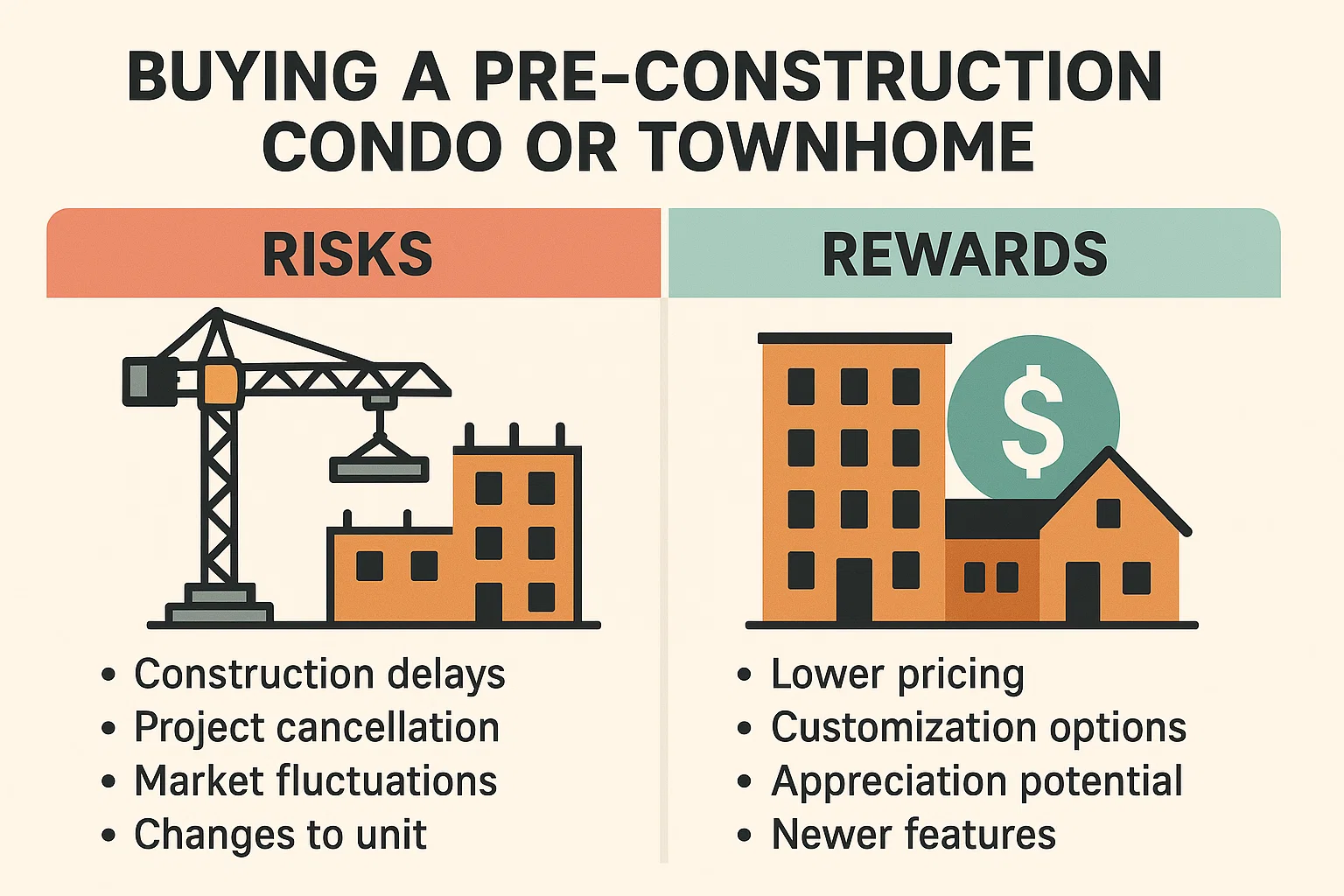
Buying a pre-construction condo or townhome means signing a contract for a home that doesn’t exist yet. In South Florida that might be a tower in Miami sold off floor plans, or a townhome community where the first buildings are still concrete slabs. You get today’s price, first pick of units and a brand-new home. In exchange, you wait, and you trust the developer to finish what it promised.
Florida gives buyers real protections on this kind of purchase, but they only help if you know where to find them in the contract. This guide covers how condos and townhomes differ legally, your cancellation and deposit rights, the risks that actually happen, how financing works, and the questions to ask before you sign.
Start here: is it a condo or a fee-simple townhome?
“Townhome” describes how a home looks, not how you own it. A two-story attached home can be sold as a condominium or as a fee-simple townhome, and the difference affects your insurance, your legal rights and your loan.
- Condominium: You own your unit and a share of the common elements. The association owns and insures the building structure, and the purchase falls under Florida’s Condominium Act, Chapter 718.
- Fee-simple townhome: You own the structure and the land under it. An HOA under Chapter 720 handles shared areas, and you usually insure the whole building yourself.
- Cooperative: You own shares in a corporation that owns the building. Co-ops are rare in new construction.
Lennar’s Solstice in Miami is a good example of why this matters: it offers townhome-style homes under the condominium form of ownership. Ask the sales team which one you’re buying and read the declaration to confirm.
| New condominium | Fee-simple townhome | |
|---|---|---|
| What you own | The unit plus a share of common elements | The building and the land under it |
| Governing law | Chapter 718 (Condominium Act) | Chapter 720 (HOA Act) |
| Insurance | Association insures the structure. You buy an HO-6 policy for the interior. | You usually insure the whole structure with an HO-3 policy, unless the HOA covers it. |
| Exterior upkeep | Association | Set by the declaration. It could be you or the HOA. |
| Right to cancel | 15 days after signing and receiving the required documents | Three days only if you didn’t get the HOA disclosure summary before signing |
| Deposit protection | Deposits up to 10% held in escrow | Escrow rules for deposits up to 10%, but the buyer can waive them in writing |
| Financing | The lender reviews the project as well as you | Standard single-family lending |
Your rights under Florida law
The 15-day right to cancel a new condo
When you buy a new condominium from a developer, Florida law lets you cancel the contract within 15 days after you sign it and receive all the required documents, such as the prospectus, the declaration and the estimated operating budget. If the developer later amends the documents in a way that materially hurts you, you get another 15 days from receiving that amendment. You can’t waive this right. If you plan to use it, send written notice before the deadline, and count from the date you received the last required document.
How your deposit is protected
For a new condo, deposits up to 10% of the purchase price must be held in escrow and can’t be spent on construction. Money above 10% can be used for construction only if your contract allows it and includes the bold-type disclosure Florida requires. With South Florida tower projects, deposit schedules often run well past 10%, so read that section before you wire anything. The portion above 10% may be spent building the project.
For a fee-simple townhome or single-family home, Florida’s deposit statute sets escrow rules for deposits up to 10% of the price. Buyers can waive that protection in writing, and some contracts include the waiver. Look for it.
The HOA disclosure summary
If you’re buying in an HOA community and didn’t receive the disclosure summary before signing, you can cancel within three days after receiving it or before closing, whichever comes first. Our HOA vs. CDD guide explains what else to request.
Completion dates and outside dates
Contracts list an estimated completion date and, usually, an outside date after which you can cancel and get your deposit back if the home isn’t finished. Most also include delay clauses for hurricanes, supply problems and permits that push those dates out. Know both dates and the conditions attached to them.
The risks that actually happen, and how to manage them
The project is delayed or cancelled
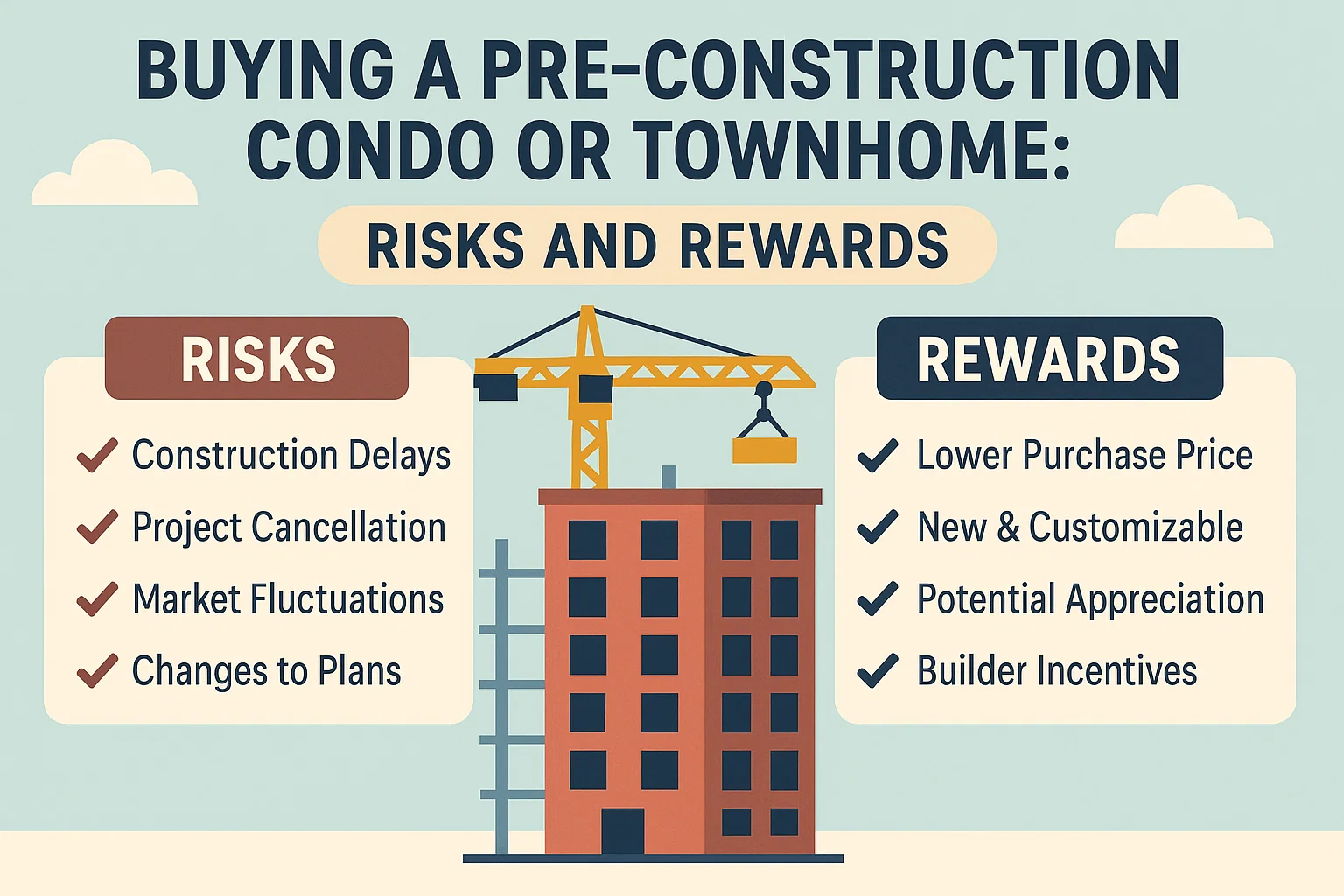
If sales are slow or construction financing falls through, a developer may push the timeline or drop the project. Escrowed deposits should come back to you, but your plans are on hold in the meantime. Check the developer’s track record on finished projects, confirm where your deposit is held and know your outside date.
The developer changes
Projects are sometimes sold to another developer partway through. Contracts usually let the developer assign them and substitute materials of “equal or better quality.” Read the assignment and substitution clauses so you know what can change without your consent.
Unsold units become rentals
A developer holding unsold inventory may rent it out. That changes how the community feels, and lenders pay attention to how many units are investor-owned. Ask what the developer plans to do with unsold homes.
The market moves before closing
The appraisal happens near closing, not at contract. If prices soften, the appraisal could come in below your price and you’d have to cover the difference in cash. If prices rise, you may close with built-in equity. That’s the reward for taking the timing risk.
Dues and insurance come in higher than estimated
The operating budget in your documents is an estimate. Final association dues and insurance premiums at closing can be higher, especially with Florida’s insurance market. Leave room in your budget.
You can’t flip the contract
Many contracts prohibit assigning your purchase to someone else before closing, or charge a fee to do it. Investors should read this clause first.
Deposits and financing
Deposit structures vary widely. South Florida tower projects often collect deposits in stages, at contract, at groundbreaking and at later milestones, and the total can reach 20% or more of the price before you close. Townhome communities from national builders usually take a smaller deposit at contract and the rest at closing through your mortgage.
Your loan isn’t final until closing, which could be a year or more away. Get pre-approved before you sign so you know you qualify today, then avoid changing jobs, opening new credit or making large purchases while you wait. Standard rate locks don’t last that long and extended locks are expensive, so plan to lock closer to completion. Our guide to financing a new construction home walks through the timeline.
With a condo, the lender reviews the project as well as you: how many units are sold, how many are investor-owned, the budget and reserves, insurance and any litigation. A building that doesn’t meet those standards may only qualify for portfolio loans with larger down payments and higher rates. Ask the developer which loan programs the project is approved for, and talk to your lender early.
If you’re buying to rent or as a second home, there’s good news on taxes. Starting January 1, 2027, Amendment 3, which Florida voters approved in November 2026, lowers the cap on yearly assessment increases for non-homestead property from 10% to 5%.
Condo safety rules after Surfside
Since 2022, Florida has required milestone structural inspections for condo buildings three or more habitable stories tall at 30 years of age and every 10 years after that. Those buildings also need a structural integrity reserve study every 10 years, and associations can no longer waive or underfund reserves for the items that study covers. A brand-new building is decades away from its first milestone inspection, but expect budgets that set aside real money for structural reserves. That’s part of why condo dues across Florida have gone up.
Questions to ask before you sign
- Is this a condominium or a fee-simple townhome? Can I see the declaration?
- How many homes will be built, and how many are already under contract?
- When does construction start, what’s the estimated completion date, and what’s the outside date?
- Who holds my deposit, and how much of it can be used for construction?
- What are the estimated monthly dues, what do they cover, and is the developer guaranteeing them for a set period?
- When does the developer turn the association over to owners?
- Is there a CDD, and what will my annual assessment be?
- How is sound controlled between homes? Ask about concrete block party walls and the floor and ceiling assemblies in stacked units.
- What fire protection is built in, such as sprinklers and fire-rated walls between units?
- What are the rental rules, including minimum lease terms and short-term rentals?
- How much parking comes with the home, and where do guests park?
- What are the pet rules?
- What’s standard and what’s an upgrade? Can I get the spec sheet for my unit?
- For townhomes, which exterior changes will owners be allowed to make later?
- What has this developer finished nearby, and can I see it?
Buying a townhome with kids
Townhomes can be a great fit for families, with a few things to weigh. Check the layout: some plans put every bedroom upstairs, while others have a first-floor bedroom. An end unit shares one wall instead of two, which helps with noise in both directions. Look at the amenities for kids, such as a pool, playground or open lawn, and drive the community at school drop-off time. And look up the assigned schools yourself rather than relying on the sales sheet.
Pre-construction condos and townhomes in South Florida
A few current examples from the builders we cover:
- Miami-Dade: Lennar’s Solstice in Miami (townhome-style condominium), plus Saltaire in Florida City and Aurora Place in Hialeah, both listed as coming-soon townhome communities at the time of writing. See all new construction townhomes in Miami-Dade.
- Broward: Pulte Homes’ Coral Edge in Margate. See all new construction townhomes in Broward.
- Palm Beach: Pulte Homes’ Everton in Lantana and The Domaine at SoSo in West Palm Beach, and Mattamy Homes’ Forest Townhomes in Lake Worth. See all new construction townhomes in Palm Beach County.
- Treasure Coast: Mattamy Homes’ Newfield Rosette Park Townhomes and Villas in Palm City. See new construction townhomes in St. Lucie County.
Frequently asked questions
Can I back out of a pre-construction condo contract in Florida?
Yes, within 15 days after signing and receiving all the required documents from the developer, and again within 15 days of receiving any amendment that materially and adversely changes the offering. The right can’t be waived. After that, your options depend on the contract.
Is my deposit safe?
On a new condo, deposits up to 10% of the price must stay in escrow. Anything above 10% can be used for construction if your contract says so. On a fee-simple home, check whether the contract includes a waiver of the escrow protection.
How much do I need to put down on a pre-construction condo?
It depends on the project. Tower projects often require staged deposits that reach 20% or more before closing, while townhome communities from national builders usually ask for less at contract. Your lender will set the down payment needed at closing.
What happens if the developer doesn’t finish?
Your contract’s outside date controls. If the home isn’t complete by then, subject to any delay clauses, you can usually cancel and recover your escrowed deposit. Money already released for construction is harder to get back.
Is a townhome the same as a condo?
Not always. Some townhomes are sold fee simple and others under the condominium form of ownership. The declaration tells you which one you’re buying.
Can I sell my contract before closing?
Many developers prohibit assignments or charge a fee for them. Read the assignment clause before you sign if you might want out early.
Keep reading
Still deciding between home types? Our guide to condos vs. townhomes vs. single-family homes compares them side by side, and our contract-to-closing guide shows what happens between signing and getting your keys.
Written by David, a licensed real estate agent with 20 years in the business. Updated November 2026.