Flooring is one of the first big choices you make at the design center, and it’s one of the hardest to change later. It covers almost every square foot of the house, it sets the look of each room and it has to handle sand, pets, kids, spilled drinks and, in South Florida, a lot of humidity. The right floor makes a new home feel finished. The wrong one can buckle, stain or wear out years early.
This guide compares the main flooring materials, explains which ones hold up best in our climate, covers the tile trends you’ll see in new homes right now and shows how to keep each type looking good. You’ll also find tips for homes with kids and pets, eco-friendly options and the grout details most buyers never think about until it’s too late.
Flooring materials compared
| Material | Water resistance | Scratch resistance | Feel and sound | Best rooms | Relative cost |
|---|---|---|---|---|---|
| Porcelain tile | Excellent | Excellent | Hard, cool, can echo | Everywhere, including baths and lanais | $$ to $$$ |
| Ceramic tile | Very good (glazed) | Good | Hard, cool | Baths, laundry, kitchens | $ to $$ |
| Luxury vinyl plank (LVP) | Excellent (waterproof core) | Good | Softer and quieter than tile | Living areas, bedrooms, kitchens | $ to $$ |
| Laminate | Fair (water-resistant types better) | Very good | Firm, can sound hollow | Bedrooms, living rooms | $ to $$ |
| Engineered hardwood | Fair | Fair | Warm, natural | Living and dining rooms, bedrooms | $$ to $$$ |
| Solid hardwood | Poor | Fair | Warm, natural | Dry rooms upstairs | $$$ to $$$$ |
| Carpet | Poor | Not applicable | Soft, quiet, warm | Bedrooms, media rooms | $ to $$ |
| Natural stone | Good when sealed | Varies by stone | Hard, cool, luxurious | Entries, baths, living areas | $$$ to $$$$ |
| Polished concrete | Good when sealed | Very good | Hard, modern | Living areas, lofts, garages | $ to $$$ |
Costs vary a lot by product, size and installation, so treat the dollar signs as a way to compare materials rather than a price quote. Ask your builder for the price of each upgrade per square foot, installed.
Tile: the South Florida default
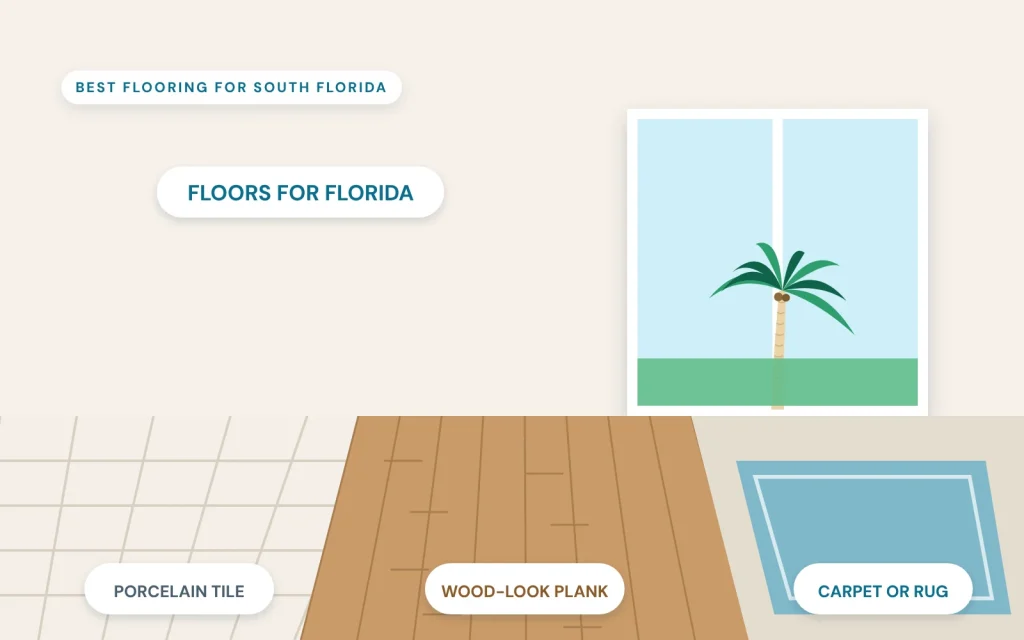
Walk through most new homes in Miami-Dade, Broward and Palm Beach and you’ll see tile in the main living areas. There’s a reason. Tile shrugs off humidity, sand and spills, it stays cool underfoot, and it survives a minor water leak or a storm surge far better than wood or carpet.
Porcelain vs. ceramic
Porcelain is a type of ceramic tile made from denser clay and fired at higher temperatures. Under the industry standard, ANSI A137.1, a tile counts as porcelain only if it absorbs 0.5% of its weight in water or less. That density makes porcelain tougher, more stain resistant and suitable for outdoor lanais and pool decks. Glazed ceramic tile costs less and works well on walls and in baths, but it chips more easily and isn’t rated for most outdoor use.
Slip resistance
Look for the DCOF rating on the tile’s spec sheet. For level interior floors that will get wet, like bathrooms, kitchens and laundry rooms, choose a tile rated 0.42 or higher. Polished tile looks great in a foyer but can be slick when wet, so save it for dry areas.
Tile trends you’ll see in new homes
- Wood-look porcelain planks: the look of oak or walnut with the durability of tile. Longer planks, like 8 by 48 inches, look more like real wood. Ask for a staggered layout and minimal grout lines.
- Large-format tile: 24 by 48 inches and bigger means fewer grout lines and a calm, modern look that makes rooms feel larger. Large slabs need a very flat subfloor and an experienced installer.
- Stone and concrete looks: porcelain that mimics limestone, travertine, marble or polished concrete gives you the style without sealing or etching.
- Cement and encaustic patterns: bold, colorful patterned tile is popular in baths, laundry rooms and entries. True cement tile is porous and needs sealing; porcelain versions give the look with less upkeep.
- Hexagon, basketweave and herringbone: small shapes and patterns add character in baths and mudrooms.
- Muted, warm colors: soft beiges, warm grays and creamy whites have replaced the cool gray look of the last decade.
Luxury vinyl and laminate
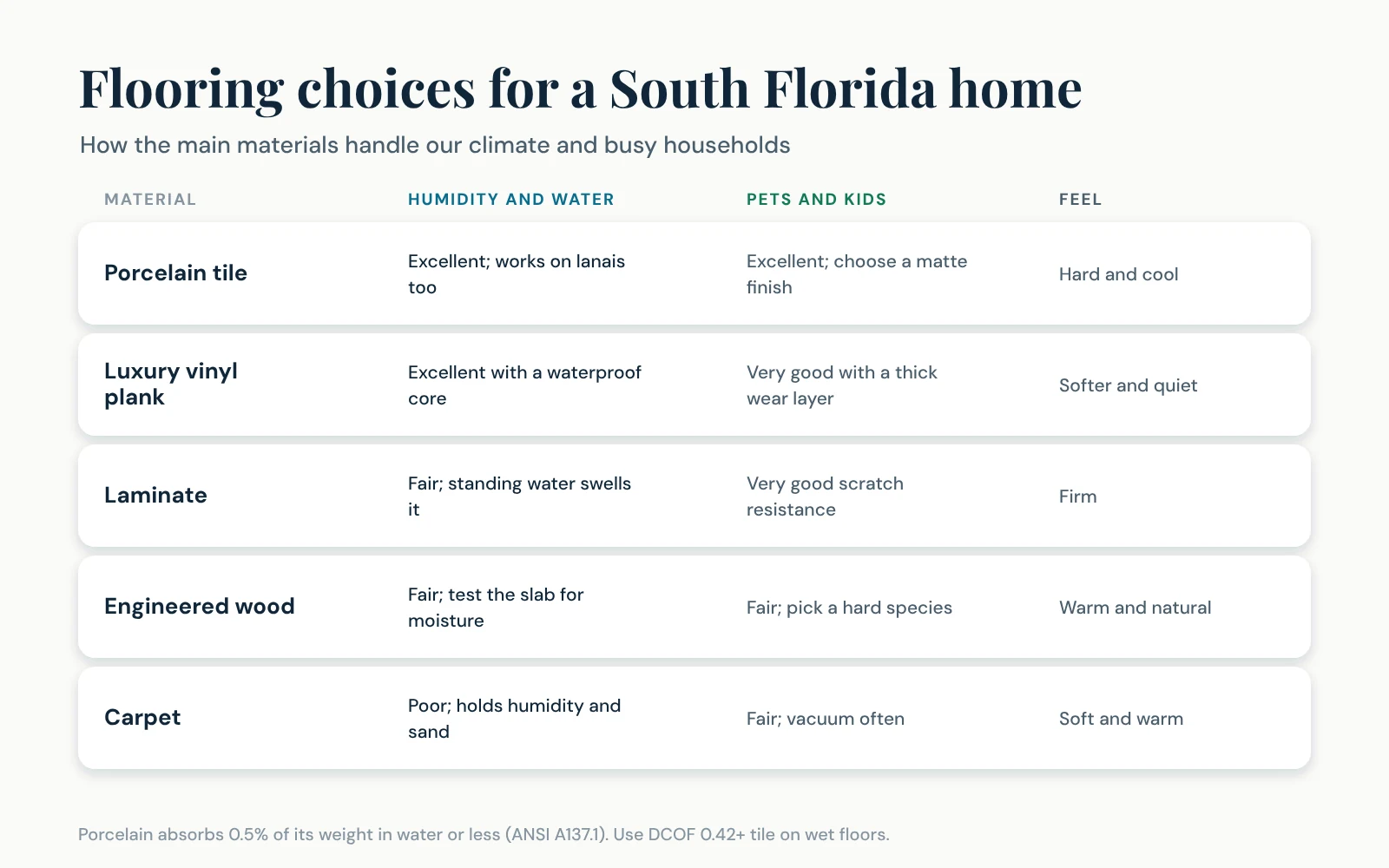
Luxury vinyl plank has become one of the fastest-growing flooring choices in the country. Good LVP has a rigid, waterproof core, a printed wood or stone layer and a clear wear layer on top. Thicker wear layers, often 12 to 20 mil, hold up better to pets and heavy traffic. It’s softer and quieter than tile, which makes it a favorite for bedrooms and second floors.
Laminate uses a fiberboard core with a photo layer and a tough melamine top. It resists scratches very well, but standing water can swell the core. Newer water-resistant laminates are better, but in South Florida, LVP or tile is usually the safer choice for kitchens and baths.
Hardwood and engineered wood
Nothing feels quite like real wood. But most South Florida homes sit on a concrete slab, and slabs can release moisture for months after construction. Solid hardwood nailed over plywood is common up north and rare here. If you want wood, engineered hardwood is the better fit: a real wood top layer bonded to a stable plywood core that moves less with humidity. Ask your installer to test the slab’s moisture and use the right underlayment or vapor barrier.
Bamboo and cork
Bamboo is a fast-growing grass, not a tree. Strand-woven bamboo, made from compressed fibers, is much harder than horizontal or vertical plank bamboo and holds up better to pets. It still scratches and doesn’t like standing water. Cork is soft, warm and quiet underfoot, and it’s a good choice for playrooms, but it dents under heavy furniture and needs sealing.
Carpet
Carpet has gotten softer and more stain resistant, and many builders still put it in bedrooms as a standard. It’s quiet, warm and comfortable for kids playing on the floor. The downsides in our climate are humidity, allergens and sand.
- Vacuum often: once or twice a week, and more in high-traffic areas or with pets. A vacuum with a sealed HEPA filter helps if anyone in the house has allergies.
- Stop dirt at the door: use mats inside and out, and consider a no-shoes rule.
- Blot stains fast: blot, don’t rub, and test cleaners on a hidden spot first.
- Deep clean once a year: hot water extraction removes the grit that wears fibers down.
- Protect from sun: UV fades carpet quickly near big windows. Shades or window film help.
Eco-friendly flooring
- Carpet: look for the Carpet and Rug Institute’s Green Label Plus for low emissions, and ask about recycled-content fibers.
- Resilient flooring: FloorScore certification means vinyl and laminate products meet indoor air quality limits.
- Wood: engineered wood uses less hardwood per square foot, and FSC-certified or reclaimed wood comes from responsible sources.
- Bamboo and cork: both renew quickly, but quality varies, so buy from a reputable brand.
- Tile: it lasts for decades, which is one of the most sustainable features any floor can have.
Flooring for kids and pets
Families with young kids and pets need floors that resist scratches, clean up easily, don’t get slippery and won’t trap odors. Porcelain tile and LVP are the top choices. Textured or matte finishes hide paw prints and scratches better than glossy ones. Area rugs on non-slip pads add softness where kids play. Avoid soft woods like pine, and if you want wood, choose a hard species like oak or a strand-woven bamboo with a tough finish. Our guide to pet-friendly homes covers more ideas.
Kitchens and bathrooms
Water is the main enemy here. Porcelain tile is the best choice for bathrooms and a great one for kitchens. LVP is a budget-friendly alternative that’s warmer and softer to stand on while you cook. Avoid solid hardwood and standard laminate in full baths, where splashes and steam can cause swelling and warping.
Grout: the detail that makes or breaks tile
- Sanded grout: for joints wider than 1/8 inch, common with floor tile.
- Unsanded grout: for joints 1/8 inch or narrower and for delicate surfaces like polished stone and glass tile that sand could scratch.
- Epoxy grout: nearly stain-proof and doesn’t need sealing. It costs more and is harder to install, but it’s worth it in kitchens, showers and pet areas.
- Color: a grout close to the tile color makes a floor look seamless. Darker grout hides dirt. Very light grout in a kitchen shows every spill.
- Sealing: cement-based grout should be sealed after it cures and resealed every year or two in wet areas. Spray-on sealers are fast; applicator bottles let you seal just the joints.
Keeping floors looking new
- Tile: sweep or vacuum, then damp mop with a pH-neutral cleaner. Skip vinegar on natural stone.
- LVP and laminate: use a microfiber mop and a cleaner made for the product. Avoid steam mops unless the manufacturer allows them.
- Wood: use a soft-bristle broom or a vacuum on the bare-floor setting, a barely damp microfiber mop and a wood-safe cleaner. Put felt pads under furniture legs and trim pet nails.
- All floors: use doormats, wipe spills right away and keep indoor humidity steady with your AC.
Choosing flooring for a new home in South Florida
Many builders here include tile in the main living areas and carpet or vinyl in bedrooms as standard, with upgrades to larger tile, wood-look porcelain or engineered wood at the design center. Before you sign, ask exactly which product is standard, the tile size, where it stops and starts, and whether the price includes baseboards and transitions. Our guide to design center upgrades explains which upgrades are worth it.
A few local tips: tile or LVP throughout the first floor makes sense in flood-prone areas, since both survive water far better than carpet or wood. Light colors keep rooms feeling bright and cool. And if you live near the beach, assume you’ll track in sand and pick a finish that hides it. You’ll see these choices in new communities from Doral and Pembroke Pines to Port St. Lucie, and builders like Lennar show their standard and upgraded floors in their model homes.
Frequently asked questions
What is the best flooring for a humid climate like South Florida?
Porcelain tile is the most durable and moisture resistant. Luxury vinyl plank with a waterproof core is a close second and feels softer and quieter.
Is luxury vinyl plank better than tile?
Not better, just different. Tile lasts longer and handles heat and sun better, while LVP is warmer, quieter and easier on your feet. Many homes use tile downstairs and LVP or carpet in bedrooms.
Can I put hardwood floors on a concrete slab?
Yes, but choose engineered hardwood and have the slab tested for moisture. Use the underlayment or vapor barrier the manufacturer requires.
What is the difference between porcelain and ceramic tile?
Porcelain is a denser type of ceramic tile that absorbs 0.5% of its weight in water or less. It’s tougher and can go outdoors, while ceramic is lighter, cheaper and best indoors.
What are the current tile flooring trends?
Wood-look porcelain planks, large-format tile, stone and concrete looks, patterned cement-style tile in small rooms and warm, muted colors.
Keep reading
- Kitchen Countertops and Surfaces: Quartz, Granite, Porcelain and More
- Wall Ideas: Wallpaper, Art and Drywall Textures
- New Home Maintenance Checklist: Your First Year and Beyond
- How to Choose a Floor Plan for a New Home
Explore more in Home Design and Living.
Written by David, a licensed real estate agent with 20 years in the business. Updated November 2026.