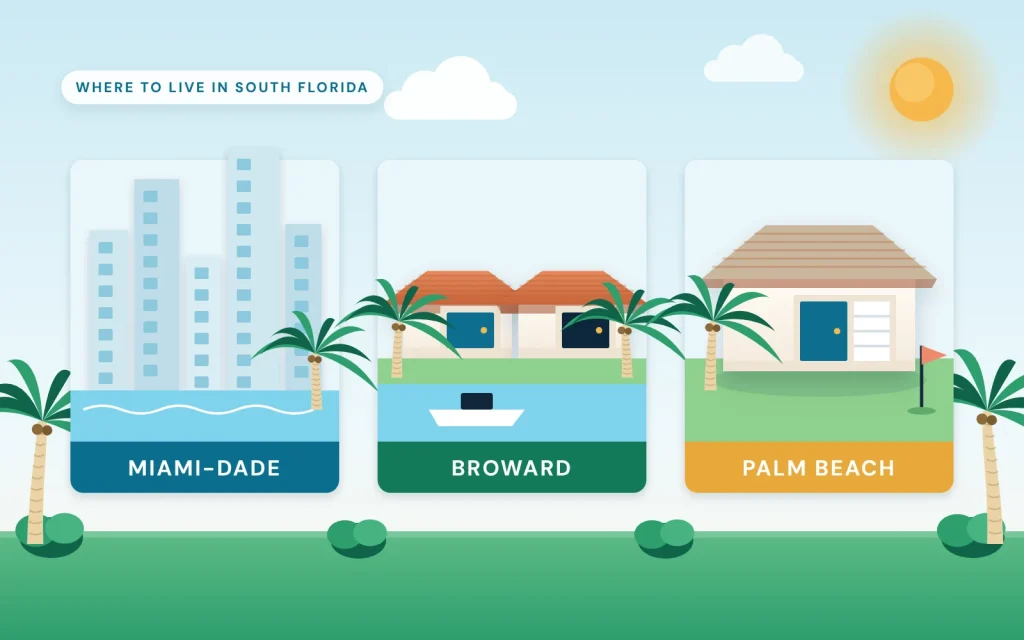
When people say they’re moving to South Florida, they usually mean one of three counties: Miami-Dade, Broward or Palm Beach. Together they’re home to more than six million people and stretch about 110 miles from the Florida Keys to Jupiter. From a distance they can look like one long, sunny metro area. Up close, each has its own pace, price range, traffic patterns and options for new construction.
I’ve helped buyers settle in all three counties for 20 years. This guide compares them side by side: who each county suits, what homes cost, where builders are still building and what to think about for commutes, schools, taxes and insurance. If you’re still early in the process, our moving to South Florida checklist covers the logistics.
The three counties at a glance
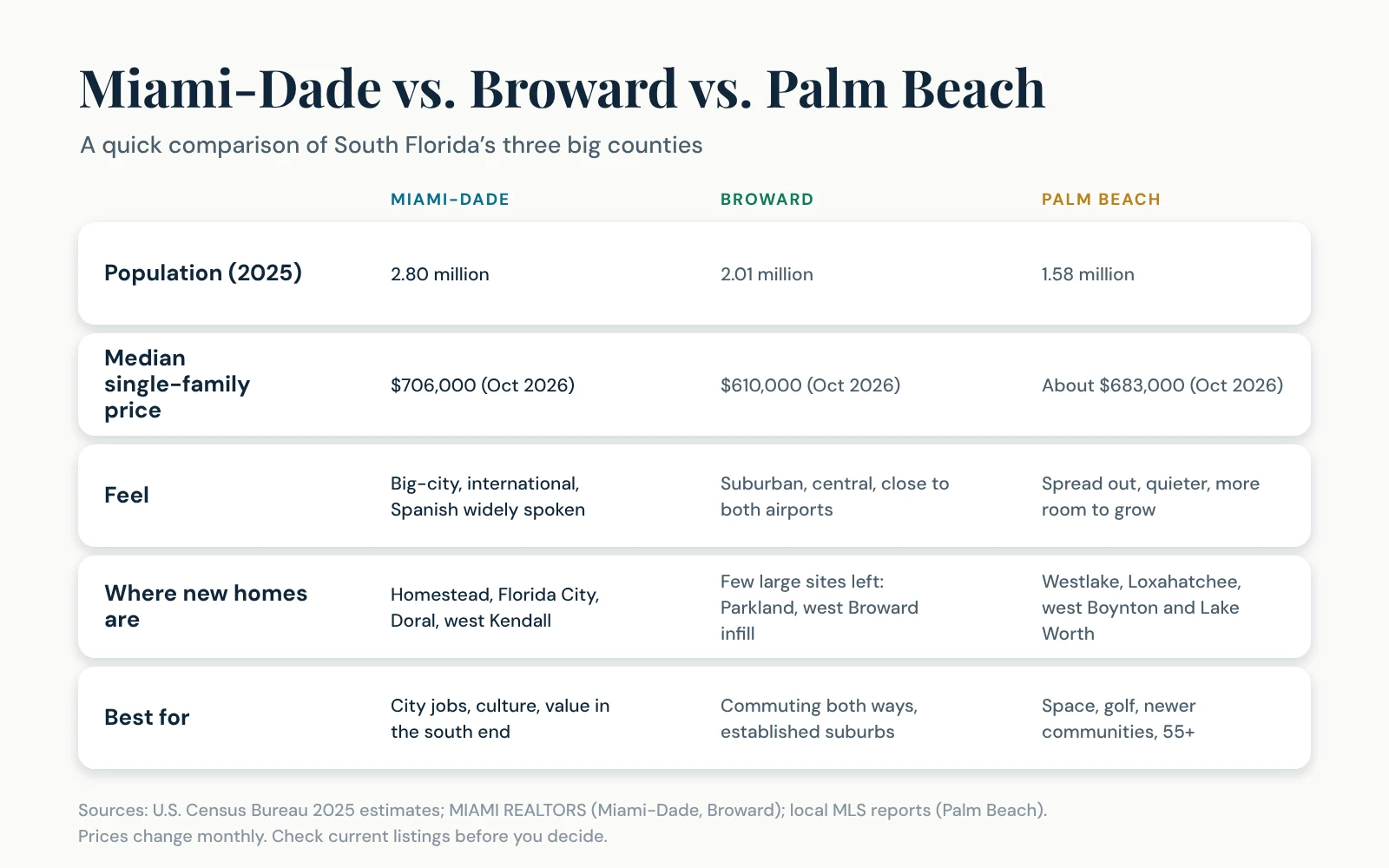
| Miami-Dade | Broward | Palm Beach | |
|---|---|---|---|
| Population (2025 estimate) | 2.80 million | 2.01 million | 1.58 million |
| Median single-family price, October 2026 | $706,000 | $610,000 | About $683,000 |
| Main city | Miami | Fort Lauderdale | West Palm Beach |
| Airports | Miami International | Fort Lauderdale-Hollywood | Palm Beach International |
| New construction | South Dade and Doral | Limited, mostly infill | Plenty, especially west and north |
Sources: U.S. Census Bureau Vintage 2025 estimates; MIAMI REALTORS October 2026 reports for Miami-Dade and Broward; local MLS reports for Palm Beach. Prices change every month.
Miami-Dade: big city, international energy
Miami-Dade is Florida’s most populous county and its most international. More than half of residents were born outside the United States, and Spanish is spoken nearly everywhere. It’s the region’s center for finance, trade, tourism, the arts and nightlife, with PortMiami and Miami International Airport anchoring the economy.
Who it suits
- People who work in Miami, Brickell, Coral Gables, Doral or near the airport
- Buyers who want city culture, dining and an international community
- Families looking for the most affordable new single-family homes in South Florida, in the south end of the county
Where new homes are
Miami-Dade has an Urban Development Boundary that limits building toward the Everglades, so most large new communities are in the south and west. Homestead and Florida City have the most new single-family homes and the best prices, Cutler Bay sits between them and the city, and Doral offers newer townhomes and condos close to the airport and jobs. Downtown Miami is the center of the pre-construction condo market.
Trade-offs
Prices near the coast and in established neighborhoods are the highest in the region, traffic on US-1, the Palmetto and the Turnpike can be heavy, and insurance costs are higher close to the water. South Dade buys you space and value but often means a longer drive north.
Broward: central, suburban and nearly built out
Broward sits between Miami and Palm Beach, which makes it a natural choice for households with jobs in both directions. Fort Lauderdale is the hub, with its beaches, canals, Port Everglades and Fort Lauderdale-Hollywood International Airport, while western Broward is a string of established suburbs like Pembroke Pines, Miramar, Weston, Davie, Coral Springs and Parkland.
Who it suits
- Commuters who split time between Miami-Dade and Palm Beach
- Families who want established suburbs with parks, sports leagues and well-regarded schools
- Boaters, thanks to Fort Lauderdale’s network of canals
Where new homes are
Broward has very little open land left, so new construction is mostly smaller infill communities and townhomes. Parkland has some of the last larger single-family communities, and you’ll find newer homes and townhomes in Pembroke Pines, Davie and Coconut Creek. See all new construction townhomes in Broward.
Trade-offs
With so little new land, buyers who want a brand-new home have fewer choices and more competition. I-95, I-595 and the Sawgrass Expressway get congested at rush hour, and coastal neighborhoods carry higher flood and insurance costs.
Palm Beach: room to spread out
Palm Beach County runs from Boca Raton in the south to Jupiter and Tequesta in the north, and it reaches far inland toward Lake Okeechobee. It feels quieter and more spread out than its neighbors, with more golf, more 55+ communities and more land for new building. West Palm Beach has grown into a business hub of its own.
Who it suits
- Buyers who want a newer home with a bigger lot or more amenities
- Retirees and active adults, with one of the largest concentrations of 55+ communities in Florida
- People working in West Palm Beach, Boca Raton or Palm Beach Gardens, or working remotely
Where new homes are
The west and north of the county have the most active building. Westlake is a newer city built around master-planned neighborhoods, Loxahatchee offers more land, and west Boynton Beach and Lake Worth are home to large communities from builders like GL Homes. To the north, Palm Beach Gardens and Jupiter offer upscale new homes. South county includes the Agricultural Reserve, where development is limited and lots tend to be larger.
Trade-offs
Commutes to Miami are long, and western communities can be a drive from the beach. Prices in coastal towns and the most popular school zones are high, and some western areas have fewer shopping and dining options, though that’s changing quickly.
Getting around
All three counties are connected by I-95, Florida’s Turnpike and US-1. Two rail lines help too: Brightline stops in Miami, Aventura, Fort Lauderdale, Boca Raton and West Palm Beach, and Tri-Rail runs commuter trains from Miami to northern Palm Beach County. Even so, most people drive, so test your commute at rush hour before you choose. Living near your work matters more here than almost anything else.
Schools
Each county has one countywide public school district, and all three offer magnet programs, charter schools and school choice options alongside neighborhood schools. School ratings vary much more by neighborhood than by county, so check the specific schools assigned to any home on the district website and the Florida Department of Education school grades.
Taxes, insurance and flood risk
- Property taxes vary more by city than by county, because cities, school districts and special districts each set their own rates. Newer communities may also have a CDD fee on the tax bill. Our HOA vs. CDD guide explains the difference.
- Homestead exemption lowers taxes on your primary residence in all three counties and limits how fast your assessed value can rise. See our homestead exemption guide.
- Insurance costs depend on distance from the coast, the home’s age, roof and windows, and the flood zone. New homes built to the current Florida Building Code usually cost less to insure. Read our Florida homeowners insurance guide.
- Flood zones change block by block in all three counties. Check the FEMA flood map and get a flood quote before you sign. Our flood zone guide explains how.
Which county fits you?
| If you want | Look first at |
|---|---|
| City life, culture and an international community | Miami-Dade |
| The lowest prices on a new single-family home near Miami | South Miami-Dade (Homestead, Florida City) |
| A central location for jobs in two counties | Broward |
| An established suburb with mature parks and schools | Western Broward |
| A newer home with more room and amenities | Western and northern Palm Beach |
| A 55+ active adult community | Palm Beach, with options in all three |
| Even more value and space | The Treasure Coast: St. Lucie and Martin counties |
Don’t forget the Treasure Coast
If prices in the big three stretch your budget, many buyers keep driving north. St. Lucie County, especially Port St. Lucie, has some of the most active new home building in Florida at lower prices, and Martin County offers a quieter, small-town feel. Both work well for remote workers and retirees. Our new construction homes under $400K page is a good place to compare.
How to decide
- Start with your commute or how often you’ll need to reach the airport, family or the office.
- Set a full monthly budget that includes taxes, insurance, HOA or CDD fees and flood insurance, not just the mortgage.
- Decide new construction or resale. Our new construction vs. resale guide walks through the trade-offs.
- Visit at different times, including a weekday rush hour and a summer afternoon.
- Narrow to two or three cities and tour model homes and neighborhoods in each.
If you’re moving from another state, our guide to buying a home from out of state explains how to do most of this remotely, and our first 30 days in a new home guide helps once you have the keys.
Frequently asked questions
Which is cheaper, Miami-Dade, Broward or Palm Beach?
Broward had the lowest countywide median single-family price of the three in October 2026, but the cheapest new single-family homes are often in south Miami-Dade, in Homestead and Florida City. Prices vary more by city than by county.
Is Broward or Palm Beach better for families?
Both have strong suburban options. Western Broward offers established suburbs like Weston, Coral Springs and Parkland, while western and northern Palm Beach have more new communities with large amenity packages. Compare the specific schools for each home.
Where is the most new construction in South Florida?
Palm Beach County and south Miami-Dade have the most active building among the three counties. Broward has little open land left. St. Lucie County, to the north, is one of the busiest new home markets in Florida.
Which county is best for retirees?
Palm Beach has the largest selection of 55+ communities, but there are options in all three counties and on the Treasure Coast. See our 55+ communities.
Is it easy to commute between the counties?
It’s possible but can be slow at rush hour. Brightline and Tri-Rail help for trips between downtowns. Living close to work makes daily life much easier.
Do I need flood insurance in South Florida?
Lenders require it in high-risk flood zones, and it’s worth considering everywhere, since standard homeowners policies don’t cover flooding.
Keep reading
- Moving to South Florida: The Complete Moving Checklist
- Buying a Home in South Florida from Out of State
- Moving Into a Brand-New Home: Your First 30 Days
Explore more in Moving to South Florida.
Written by David, a licensed real estate agent with 20 years in the business. Updated November 2026.