
New Construction vs. Resale Homes in South Florida: How to Choose

Most buyers I meet in South Florida start the new construction vs. resale debate already leaning new. Then they see a CDD line on a tax estimate, or a resale a few miles closer to the beach for the same money, and the choice gets harder. Either path can be the right one. What matters is the full cost of owning each home for the years you plan to live there, not just the list price.
This guide puts new construction and resale side by side on price, insurance, property taxes, HOA and CDD fees, maintenance, warranties, location and timing. It also clears up a few myths about buying new that cost people money.
The short answer
New construction usually wins on insurance, energy use and repair risk for the first decade. Resale usually wins on location, lot size, mature trees, negotiating room and how fast you can move in. Here in South Florida, the insurance gap alone can cover part of a higher purchase price, while CDD assessments in many newer communities can take some of that advantage back. You won’t know which way it tips until you price both homes the same way.
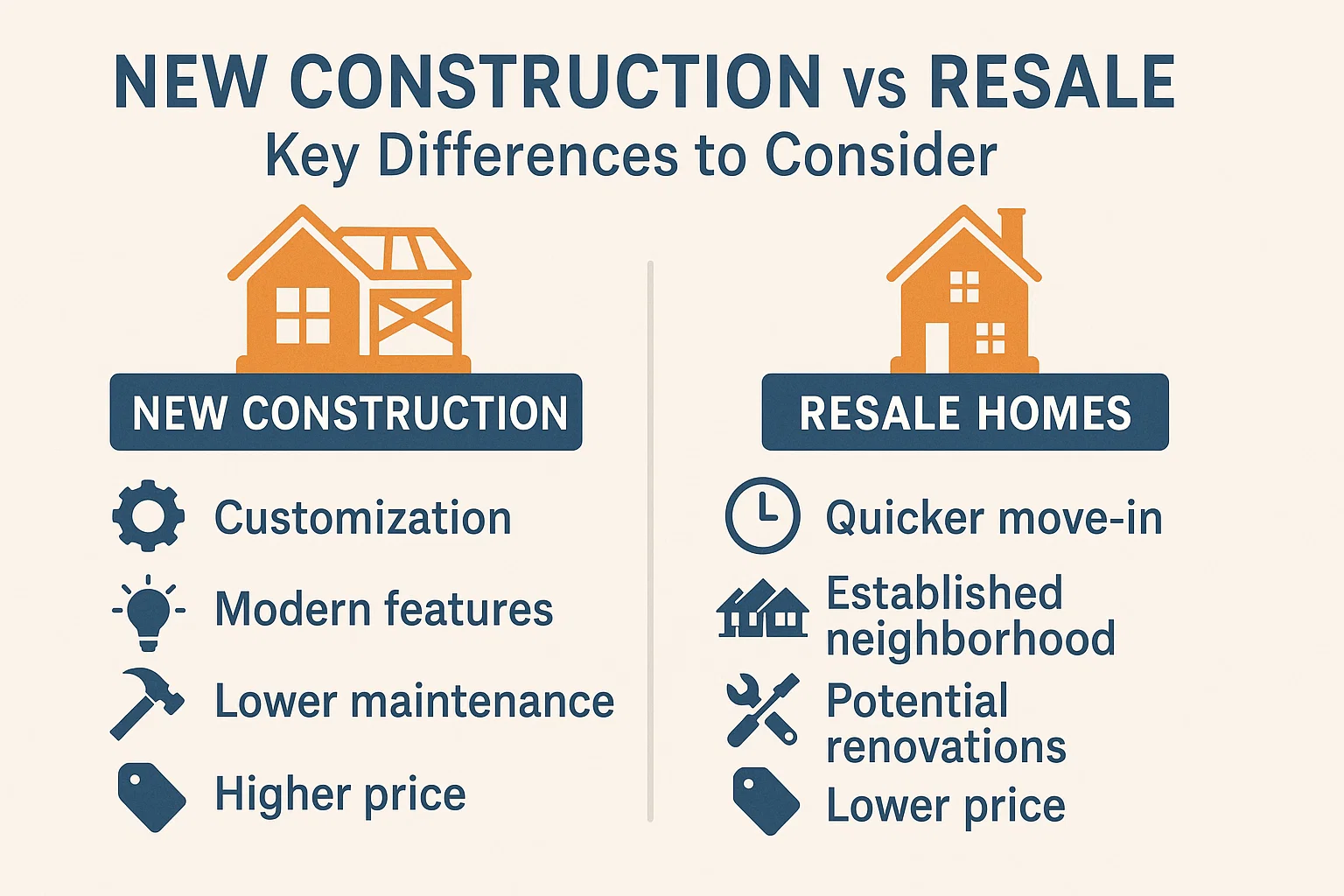
New construction vs. resale at a glance
| Factor | New construction | Resale |
|---|---|---|
| Purchase price | Base price rarely moves. Builders compete with incentives instead. | Price, repairs and credits are all negotiable. |
| Homeowners insurance | Current building code, new roof and wind-mitigation features usually mean lower premiums. | Roof age and older systems can raise premiums or trigger a 4-point inspection. |
| Property taxes | First bill may cover the land only, then jumps once the finished home is assessed. | Assessment resets to market value. You don’t inherit the seller’s capped value. |
| Community fees | HOA is standard. CDD assessments are common in master-planned communities. | HOA varies. CDDs are less common in older neighborhoods. |
| Maintenance | Few repairs early on, plus a builder warranty. | Depends on the age of the roof, AC, water heater and plumbing. |
| Location | Mostly the western and southern edges of the metro and the Treasure Coast. | Closer-in and coastal neighborhoods, established school zones. |
| Lot and landscaping | Smaller lots, young trees. | Bigger lots and shade in older areas. |
| Move-in timing | Weeks for a quick move-in home, often 6 to 12 months or more for a to-be-built home. | Usually 30 to 45 days with financing. |
| Personalization | Pick the plan, lot and finishes. | Renovate after closing. |
What you pay up front: price, incentives and negotiation
Production builders guard their base prices because every sale becomes a comparable for the next one in the community. So the negotiation moves somewhere else: closing cost credits, a mortgage rate buydown, design center credit or a discount on a lot premium. Those incentives are often tied to using the builder’s affiliated lender and title company. That can be a very good deal, but get a Loan Estimate from an outside lender too and compare the totals before you assume it is.
Resale is a more traditional negotiation: price, repairs or a seller credit, depending on how long the home has been listed and how much competition there is.
Upgrades are where new-home budgets slip. Model homes are usually loaded with options. Price the floor plan you actually want, with the finishes you actually want, before you compare it to a resale. Our guide to design center selections and upgrades covers how to keep that number in check.
Insurance: the biggest South Florida difference
Homeowners insurance is where a newer home pulls ahead most clearly in this market. Florida rewrote its building rules after Hurricane Andrew in 1992, and the statewide Florida Building Code took effect in 2002. Miami-Dade and Broward sit in the High-Velocity Hurricane Zone, which carries the toughest wind requirements in the state. A home finished in the last few years was built to the current code, with impact-rated windows and doors or approved shutters, stronger roof attachment and a brand-new roof.
Insurers price that in. Florida requires insurers to give credits for wind-mitigation features, and a new home usually qualifies for most of them. Roof age matters too. Under Florida law, an insurer can’t refuse to write or renew a policy just because a roof is less than 15 years old, and an older roof can still qualify if an inspection shows at least five years of useful life left. With an older resale, expect the carrier to ask for a 4-point inspection (roof, electrical, plumbing and HVAC), and sometimes a roof replacement before it will bind coverage.
Before you make an offer on a resale, get an insurance quote on that exact address and ask the seller for any recent 4-point and wind-mitigation reports. On a new home, ask the builder for the wind-mitigation form so your agent can shop the policy. Our guides to homeowners insurance in Florida and flood insurance and flood zones go deeper.
Property taxes: two surprises to plan for
Florida values property as of January 1 each year. If your new home wasn’t finished on that date, your first tax bill may be based mostly on the land. The next year, the completed house is on the roll and the bill can jump. Budget for the real number from the start, and check that your lender’s escrow estimate reflects it, or you could get an escrow shortage notice after the first year.
Resale buyers get a different surprise. The seller’s tax bill reflects their homestead exemption and years of Save Our Homes protection, which limits yearly increases in a homestead’s assessed value to 3% or the change in CPI, whichever is lower. None of that transfers to you. Your assessment resets to market value the year after you buy, so the seller’s bill is not your bill. If you’re selling a Florida homestead, you may be able to bring part of your Save Our Homes savings with you through portability, up to $500,000 of assessed value difference.
The exemption itself is about to get much bigger. Florida voters approved Amendment 3 on November 3, 2026. It raises the homestead exemption on non-school taxes to $150,000 in 2027 and $250,000 in 2028, while the $25,000 exemption that applies to school taxes stays. People who become Florida residents after 2026 start with the current exemption and wait five years for the larger one, so ask your county property appraiser how it applies to your purchase. Either way, you need to own and live in the home on January 1, then file for homestead by March 1 of that year. Our guide to homestead and property tax benefits has more.
HOA and CDD fees
Nearly every new community in South Florida has a homeowners association, and many master-planned ones also sit inside a Community Development District. A CDD is a special taxing district that borrowed money to build roads, drainage, utilities and sometimes amenities. You pay it back through an annual assessment on your property tax bill, often over 20 to 30 years, plus a maintenance portion that continues after the debt is gone. Florida requires the builder to disclose a CDD in bold in your contract, but it’s easy to miss on a brochure.
Plenty of older resale neighborhoods have no CDD and a modest HOA, or no HOA at all. That alone can close much of the monthly gap between a resale and a new home. Note that the homestead exemption, including the new larger one, does not reduce CDD assessments. Add HOA dues and the CDD to every payment estimate you compare. Our guide to HOA vs. CDD fees in Florida shows how to find both numbers.
Maintenance, systems and warranties
In a new home, the roof, AC, water heater, appliances and plumbing all start their clocks on closing day. Most national builders back the home with a tiered warranty, commonly one year on workmanship and materials, two years on major systems and ten years on structural components. Read your builder’s actual warranty document. Terms vary, and the structural coverage is narrower than most buyers expect.
With a resale, age is everything. In South Florida that means looking hard at the roof, the AC (10 to 15 years is a typical run in our climate), the water heater, the electrical panel and the plumbing. Many homes built before the mid-1970s have cast-iron drain lines under the slab that corrode over time. Some homes from the late 1970s to the mid-1990s have polybutylene supply lines, which many insurers won’t accept. A thorough inspection, plus a camera inspection of the sewer line on older homes, is money well spent.
Inspect a new home too. The builder’s walk-through is not an independent inspection, and problems are cheapest to fix before closing and again before your one-year warranty ends. If a serious defect shows up later, Florida’s Chapter 558 sets out a notice-and-repair process that comes before any construction defect lawsuit, so put every warranty request in writing and keep copies. See our guides to home inspections and new home warranties.
Energy use and comfort
New homes are built to the current Florida energy code: better insulation, tighter ductwork, low-E windows and more efficient air conditioning than most homes from the 1980s and 1990s. When the AC runs most of the year, that shows up on the electric bill every month. Many builders also include smart thermostats and LED lighting as standard. Our guide to energy-efficient homes breaks down what to look for.
Location, lot size and neighborhood feel
This is resale’s strongest argument. Most land left for new subdivisions is in south Miami-Dade, western Palm Beach County and up the Treasure Coast in Port St. Lucie, Fort Pierce and Martin County. If you need to be near the coast, a particular downtown or a specific school, a resale may be the only way to get there on your budget.
A resale also shows you the finished picture: grown trees, known traffic and neighbors you can meet first. In a new community you’re buying into a plan, so ask what’s planned for nearby empty parcels and how many phases are left.
Broward County shows the trade-off clearly. With little vacant land left, most new construction there is infill townhomes and small enclaves, so lots are smaller and prices per square foot run higher. Browse new construction townhomes in Broward County to see what that looks like.
Timing: when you can move in
A financed resale usually closes in 30 to 45 days. New construction runs on the builder’s schedule. A quick move-in home is finished or close to it and can close in weeks, while a home you pick from the ground up commonly takes six months to a year, and longer in early pre-construction phases. If you have a lease ending or a home to sell, a quick move-in home narrows the gap. See our quick move-in homes guide.
A long build also affects your mortgage rate, since standard locks run 30 to 60 days and longer ones cost more. Our rate lock and buydown guide explains extended locks and float-downs.
Five myths about buying new construction
“New homes always cost more.”
The price per square foot is often higher, but owning it can cost less once you count insurance, energy and early repairs.
“You can’t negotiate with a builder.”
You usually can’t move the base price much. You can often negotiate incentives, closing costs, lot premiums or upgrades, especially on homes that are already built.
“A brand-new home doesn’t need an inspection.”
It does. Independent inspectors regularly find missing insulation, roof flashing problems and wiring issues that slipped past the builder’s punch list.
“Agents can’t help with new construction.”
They can, and the builder’s sales consultant works for the builder. Most builders pay a cooperating agent, but many require the agent to register you on your first visit, so bring your agent or have them call ahead. Here’s more on how an agent helps on a new home purchase.
“All new homes look the same.”
Exterior styles are limited to keep streets consistent, but plans, elevations, lots and finishes often give you more real choice than a resale search.
When resale is the better call
- You need a location, school zone or commute that new construction doesn’t reach.
- You want a large lot, an existing pool or mature landscaping.
- You need to close in 30 to 45 days and no quick move-in home fits.
- You’d rather avoid a CDD or keep association costs low.
- You have the budget and patience to renovate, and the roof and systems check out.
When new construction is the better call
- Insurance quotes on the resales you like are high or hard to get.
- You want low maintenance for the first several years.
- You want to choose the floor plan, the lot and the finishes.
- You’re comfortable living in a growing area while the community fills in.
- A builder incentive, such as a rate buydown, lowers your payment more than a resale price cut would.
New construction in South Florida: where to look
Here’s how the region breaks down, with communities from the builders we cover:
- Miami-Dade: Most new single-family homes and townhomes are in the south end of the county. Lennar is active around Florida City and the Miami area, and D.R. Horton’s Highland Estates is in Homestead. Browse everything in Miami-Dade County.
- Broward: Limited land means smaller, infill communities. Mattamy Homes’ Sienna and Toll Brothers’ Hanson Preserve are both in Cooper City, and Pulte Homes builds townhomes at Coral Edge in Margate. See all of Broward County.
- Palm Beach: Toll Brothers at Meravita at Boca Raton, Pulte Homes at Everton in Lantana and Mattamy Homes at Forest in Lake Worth. See all of Palm Beach County.
- Treasure Coast: Port St. Lucie is where much of the region’s new single-family building is happening, including Lennar’s Veranda Preserve The Grand East. Mattamy Homes is building at Newfield in Palm City. See St. Lucie County and Martin County.
Working with a tighter budget? Start with new construction homes under $400K.
Side-by-side checklist
Collect these for every home you’re seriously considering, new or resale, then compare the monthly totals:
- An insurance quote for that address, including wind and flood.
- A property tax estimate at your purchase price with homestead applied, not the seller’s bill.
- HOA dues and any CDD assessment, both the debt portion and the maintenance portion.
- For resale: the age of the roof, AC and water heater. For new: the warranty terms.
- An estimate of monthly utilities.
- For new: upgrades and lot premium. For resale: repairs and planned renovations.
- Closing costs after builder incentives or seller credits.
- Your move-in date and what waiting costs you in rent, storage or rate lock fees.
Frequently asked questions
Is new construction or resale cheaper in South Florida?
Resale is often cheaper per square foot. New construction can come out ahead on the monthly payment once insurance, energy and repair costs are counted, unless a CDD assessment or high HOA dues cancel out the savings. Compare the full monthly cost of both.
Is homeowners insurance cheaper on a new home in Florida?
Usually, because new homes meet the current building code, have new roofs and qualify for wind-mitigation credits. Get a quote on the specific address to be sure.
Can you negotiate the price of a new construction home?
Builders rarely cut base prices, but they often offer closing cost help, rate buydowns, upgrade credits or lot discounts. Completed inventory homes usually have the most room.
Do I need an inspection on a new construction home?
Yes. Hire an independent inspector before closing, and again shortly before your one-year warranty runs out.
Why did my property taxes go up after I bought a new home?
Your first bill may have been based on the land alone if the house wasn’t complete on January 1. Once the finished home is assessed, the bill rises. Resale buyers see a similar jump because the seller’s capped assessment resets to market value after the sale.
Next step
If the new construction vs. resale math points to new, the next decision is the builder and the community. Our checklist for choosing a home builder and our walk-through of the new construction process from contract to closing pick up where this guide leaves off. When you’re ready to look, start with new construction homes across South Florida.
Written by David, a licensed real estate agent with 20 years in the business. Updated November 2026.


