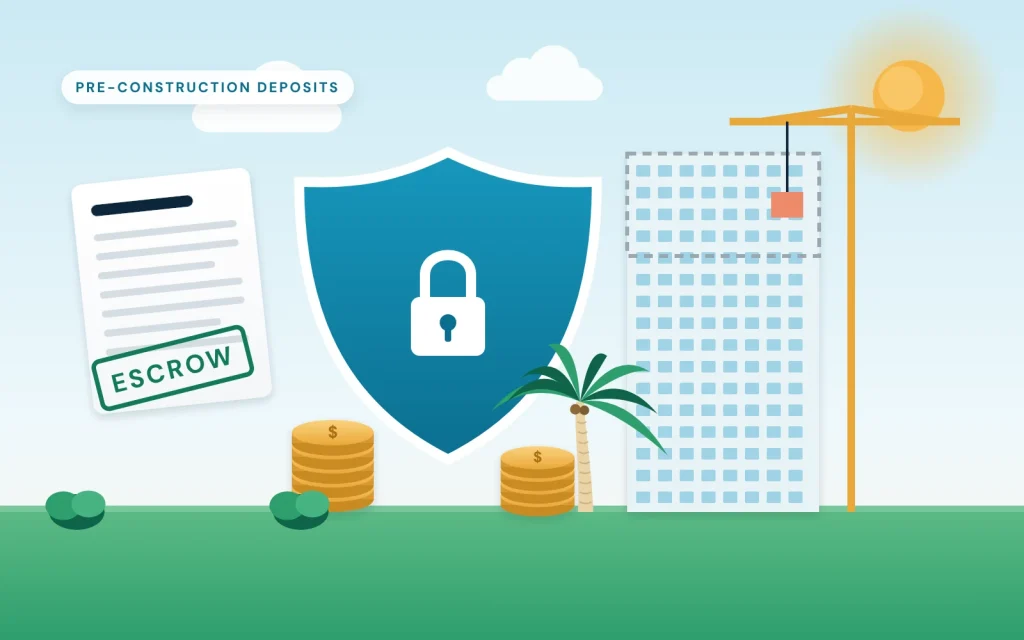
Buying pre-construction means paying real money for a home that doesn’t exist yet. In South Florida, condo developers often ask for staged deposits that add up to 20% to 50% of the price before the building is finished, and single-family builders usually want a deposit at contract plus more at the design center. That money may sit with someone else for a year or longer. So the most important question isn’t just how much you’ll put down. It’s where that money goes and what happens to it if something goes wrong.
Florida has some of the most detailed deposit rules in the country, but they work very differently for condos than for single-family homes and townhomes. This guide explains what the law requires, where the gaps are, what your right to cancel looks like and the questions to ask before you write a check. It’s general information, not legal advice, so have a Florida real estate attorney review any contract before you sign.
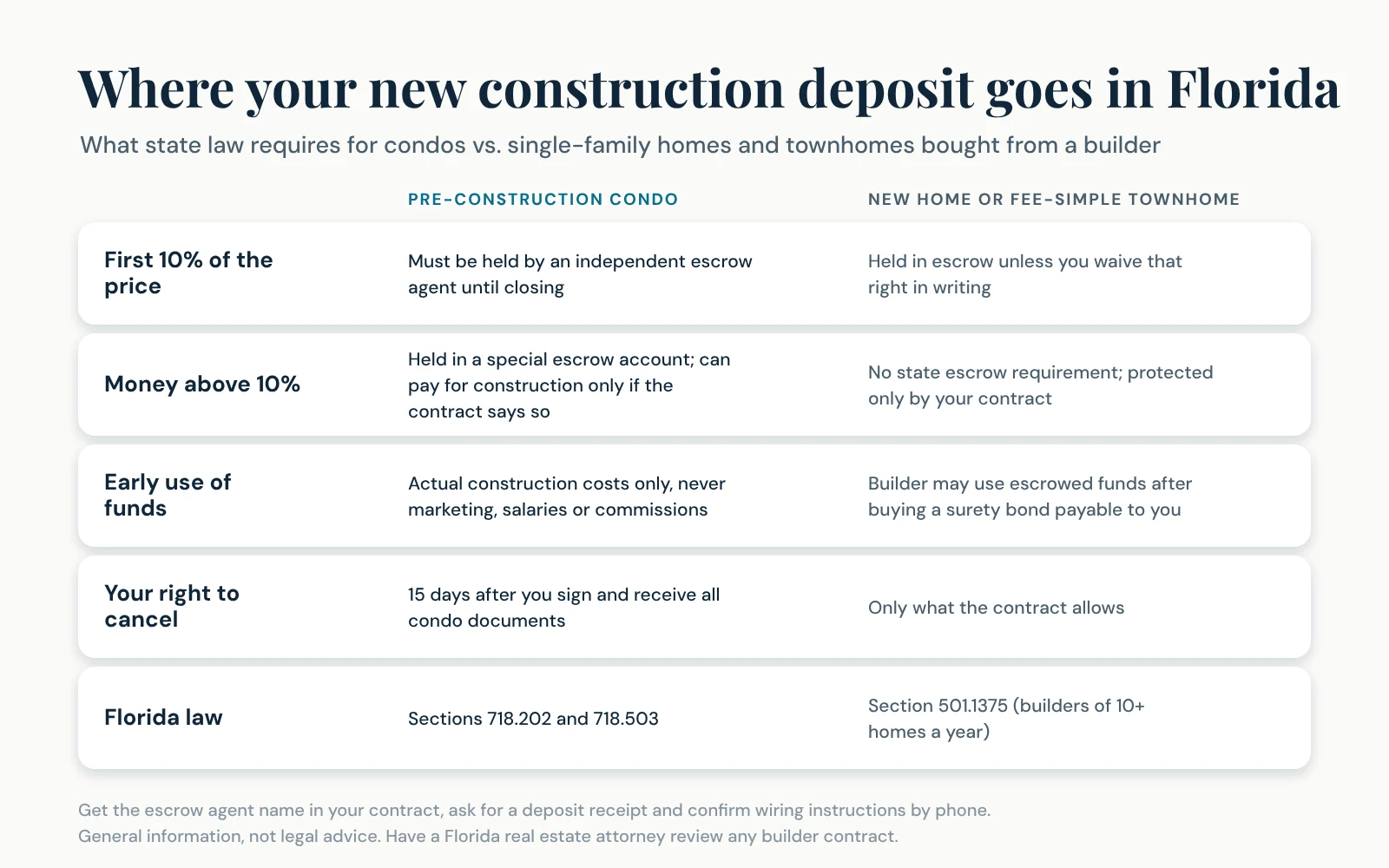
Florida deposit rules at a glance
Pre-construction condos: the 10% escrow rule
Florida’s Condominium Act, in section 718.202 of the Florida Statutes, controls deposits on condos that aren’t substantially finished when you sign. Here’s how it works:
- The first 10% goes into escrow. All payments up to 10% of the purchase price must be held by an escrow agent, not the developer. The contract has to name the escrow agent and its address, and you can ask for a receipt.
- Money above 10% goes into a special escrow account. It stays there unless the contract allows the developer to use it.
- Construction use is limited. If the contract permits it, the developer can withdraw deposit money above 10% once construction has begun, but only for actual construction and development costs, like permits, impact fees, site work and architectural or engineering fees. It can’t be used for salaries, sales commissions, advertising or marketing. A contract that allows this must say so in bold type on the first page, above your signature.
- Release at closing or default. Escrowed funds are released to the developer at closing. If you properly terminate the contract under its terms, your escrowed money, plus any interest the contract provides, comes back to you. If you default, the developer can keep it as the contract allows. If there’s a dispute, the escrow agent holds the money until it’s resolved.
The practical takeaway: the first 10% of your deposit is protected by escrow until closing. Anything above that may be spent on the building if your contract allows it, which means it’s only as safe as the project. That’s why it pays to read the deposit section of a condo contract line by line.
Reservation agreements
Before a developer can sign binding contracts, it may take reservations. A reservation deposit must be paid to the escrow agent, and a reservation is generally refundable until you sign the purchase contract. Once you sign the contract, that deposit becomes part of your contract deposit and the contract rules take over.
Your 15-day right to cancel a new condo contract
Section 718.503 gives buyers of new condos from a developer a powerful protection: the contract is voidable by you for 15 days after the later of signing it and receiving all of the required condo documents, as shown by a signed receipt. The documents include the declaration of condominium, articles, bylaws, the estimated operating budget, floor and plot plans, the frequently asked questions sheet and, for larger projects, the prospectus or offering circular.
- You cancel by giving the developer written notice within the 15 days. Your deposit is refunded.
- The developer can’t close during those 15 days unless you agree in a separate signed document.
- If the developer later amends the offering in a way that’s materially adverse to you, you get another 15 days to cancel after you receive the amendment.
- Any clause that tries to waive these rights has no effect. The right ends at closing.
Use those 15 days. Read the budget, check the reserves, look for rental restrictions and review the developer’s rights to change the building. Our pre-construction condo and townhome guide covers what to look for in the documents.
New single-family homes and townhomes: a different rule
If you’re buying a single-family home or a fee-simple townhome from a builder, the condo rules don’t apply. Instead, section 501.1375 covers deposits on one-family and two-family homes sold by builders and developers that sell 10 or more units a year statewide.
- You have a right to escrow up to 10%. The builder must tell you, in conspicuous type in the contract, that you have the right to have deposits up to 10% of the price placed in escrow with a bank, savings and loan or trust company, a Florida attorney, a licensed real estate broker or a title insurance company.
- You can waive that right, in writing. Many builder contracts include a waiver. Look for it, and ask about it before you sign.
- Withdrawals need both signatures. If you don’t waive escrow, money can only come out of the account with both your signature and the builder’s, except at closing, termination or default as the statute allows.
- The surety bond option. A builder that wants to use escrowed deposits for construction can do so after buying a surety bond, payable to you, in the amount of your deposit. The bond premium for your share may be charged to you at closing.
- Nothing above 10% is covered. The statute doesn’t require escrow for deposits above 10%, and design center upgrade deposits are often paid straight to the builder and non-refundable. That money is protected only by your contract and the builder’s financial strength.
Builders that sell fewer than 10 homes a year aren’t covered by this statute. If you’re buying from a small builder, negotiate escrow and refund terms into the contract yourself. Our guide to buying new construction walks through the builder contract, and our builder checklist helps you vet the company first.
Federal protection: the Interstate Land Sales Act
The federal Interstate Land Sales Full Disclosure Act was written to protect buyers of lots in large subdivisions sold across state lines. Since 2015, residential condo units have been exempt from its registration requirements. Many builder contracts still promise to finish the home within two years, because that commitment keeps the sale exempt. If a builder’s contract doesn’t include a completion deadline, ask why, and ask your attorney whether the Act applies.
What about the Homeowners’ Construction Recovery Fund?
Florida’s Homeowners’ Construction Recovery Fund repays homeowners who lose money because a licensed contractor violated certain laws, such as abandoning a job or mismanaging funds. For contracts signed on or after July 1, 2024, it can pay up to $100,000 per claim against a general, building or residential contractor. But the fund is built for homeowners who hire a contractor to build or improve a home on land they own. It generally doesn’t cover buying a finished or to-be-built home from a developer that owns the land. If you’re building a custom home on your own lot, ask about it; otherwise, don’t count on it.
What happens if a project is delayed or canceled?
- The developer cancels. Condo contracts often let the developer cancel if it doesn’t reach a presale target or can’t get financing. In that case, escrowed deposits are refunded.
- Construction runs late. Most contracts set an outside completion date and allow extensions for weather, hurricanes and supply delays. Know your date and what rights you have if it passes.
- The developer runs into financial trouble. Money that’s still in escrow is generally safe. Deposits already spent on construction are much harder to get back. This is the main risk of large deposits.
- You need to back out. Outside your cancellation rights and contract contingencies, walking away usually means losing your deposit. Plan for interest rates, insurance and your own finances changing before closing.
Deposit checklist before you sign
| Question | What a good answer looks like |
|---|---|
| Who is the escrow agent? | A named, independent attorney, title company or bank, listed in the contract |
| How much is escrowed? | At least the first 10%, ideally all deposits until closing |
| Can deposits over 10% be used for construction? | You know the answer, and you’re comfortable with the amount at risk |
| Did I waive escrow? | For houses and townhomes, check for a waiver clause before you sign |
| Is there a surety bond or deposit insurance? | Get a copy if the builder or developer offers one |
| When can I cancel and get my money back? | Condos: 15 days after documents; others: financing or other contingencies in writing |
| What’s the completion deadline? | A firm outside date, with clear rights if it passes |
| Are upgrade deposits refundable? | Usually not, so keep them modest until construction is underway |
| How do I pay? | Directly to the escrow agent, with wiring instructions confirmed by phone |
Protect yourself from deposit fraud
Large deposits attract scammers. Never wire money based on an email alone. Call the escrow agent or title company at a phone number you looked up yourself, confirm the account details out loud and be suspicious of any last-minute change to wiring instructions. Pay deposits to the escrow agent named in your contract, not to a salesperson, and keep every receipt.
Financing and the deposit
Your deposit usually counts toward your down payment, but you’ll still need a mortgage approval when the home is finished. Lenders also have to approve a condo building before they’ll lend in it. Our guide to financing a new construction home covers staged deposits, rate locks and closing on a pre-construction condo, and our Florida homeowners insurance guide explains what to budget once you close.
Pre-construction deposits in South Florida
Deposit structures vary a lot by product. Downtown Miami condo towers commonly ask for staged deposits tied to contract, groundbreaking and topping off, and international buyers are sometimes asked for more. Townhome and single-family communities in Doral, West Palm Beach and Port St. Lucie usually ask for a smaller deposit at contract plus design center deposits. National builders like Lennar and Toll Brothers each have their own deposit terms, so compare them side by side. You can browse current projects on our pre-construction homes and condos page.
Frequently asked questions
Is my pre-construction condo deposit safe in Florida?
The first 10% must be held in escrow by an independent escrow agent until closing. Deposits above 10% may be used for construction if your contract allows it, so that portion carries more risk.
Can I get my deposit back on a new condo in Florida?
Yes, if you cancel within 15 days after signing and receiving all the condo documents, or within 15 days after a materially adverse amendment. Outside those windows, it depends on your contract.
Do builders have to escrow deposits on new single-family homes?
Builders that sell 10 or more homes a year must offer to escrow deposits up to 10% of the price. You can waive that right in writing, so check your contract.
Can a developer spend my deposit?
A condo developer can spend deposit money above 10% on actual construction costs if the contract allows it. A home builder can use escrowed deposits after buying a surety bond payable to you.
What happens to my deposit if the developer cancels the project?
Escrowed deposits are refunded. Money already spent on construction can be hard to recover, which is why large deposits deserve extra care.
Should I hire an attorney to review a pre-construction contract?
Yes. Builder and developer contracts are written to protect the seller, and a Florida real estate attorney can explain your deposit, cancellation and completion rights before you commit.
Keep reading
- Buying a Pre-Construction Condo or Townhome in South Florida
- How to Finance a New Construction Home in South Florida
- New Home Warranties in Florida
Explore more in Pre-Construction.
Written by David, a licensed real estate agent with 20 years in the business. Updated November 2026.